
The Way After

The Day After is a peculiar movie. The film depicts the fallout of a full-scale nuclear exchange between the United States and the Soviet Union, focusing on ordinary citizens in Lawrence, Kansas. It was aired in 1983. It changed the face of the earth by sending shockwaves around the world and even initiated new rounds of disarmament talks between the two superpowers. Historians broadly agree that seeing the human reality of nuclear war onscreen accelerated Reagan’s shift from a posture of winnable nuclear doctrine toward active disarmament. Over 100 million people—roughly 62% of all viewing households in the U.S. at the time—tuned in, making it one of the most-watched television events in history. But it wasn’t limited to the U.S.: in 1987, during Gorbachev’s glasnost reforms, The Day After was broadcast across Soviet state television without cuts. Soviet viewers saw American citizens portrayed not as aggressive enemies, but as vulnerable human beings terrified of the same threat.
This world doesn’t exist anymore. The Day After is today, and we are living it. Information technology has had an impact of an equivalent order of magnitude on our societies.
The first meta-point is that there is no way such a cultural moment could ever happen again in a digital age. News cycles are counted in hours, and every subject, no matter how impactful it should be, succumbs to the iron law of social media. Even a question like “Are we alone in the universe?” (and all the UFO release/talks etc.) is barely noticed in the feed of average netizens. Doomscrollers look like those haggard survivors of the nuclear exchange in the movie that walk like zombies, barely talking or self-aware anymore.

Rising Tensions
The first half of the movie is about setting the context. Everyday life is depicted with news reports about rising geopolitical tensions playing in the background. Just like today, we live our lives surrounded by news—almost exclusively delivered via social media posts—about active wars in Iran or Ukraine and their evolution. In essence, this news has no direct influence on daily life, even when direct military confrontations start in Western Europe. It’s a bit like today where, apart from the price of gas, no direct consequences of the war can be felt by the average U.S. citizen (though it might be a different story for the average Iranian citizen).
But the film feels like it comes from another planet. And I am not talking about the lack of technology, but rather how people relate to one another, how the public space is portrayed, etc. The movie was aired 40 years after WWII, and we are now 40 years away from the 80s. My feeling is that life changed more dramatically during this second 40-year period than the first. In fact, the shift is more subtle. Between WWII and the 80s, a lot of the material aspects of life changed. We went to the moon, saw the birth of the first computers, jet airplanes, etc., yet the societal structure and culture remained stable (not discounting the 60s). During the second span, it appears that the inverse happened: few genuinely new things emerged, except for objects related to information technology. Airplanes don’t go faster or look all that different from those of the 80s (though less visible aspects like reliability, affordability, and engine efficiency have evolved). Yet society has changed in ways that would be incomprehensible to an 80s person. Just take the Supreme Court confirmation hearing where the question “Can you define ‘the word woman’?” was asked—a question that would have sounded absurd back then—to which the answer given, in all seriousness, was: “I can’t. I am not a biologist.”. Because humans reproduce sexually, being able to distinguish men from women was a precondition of our very existence. Thus, it is surely the most striking example of how far reality can be ignored in a digital culture…
Flash
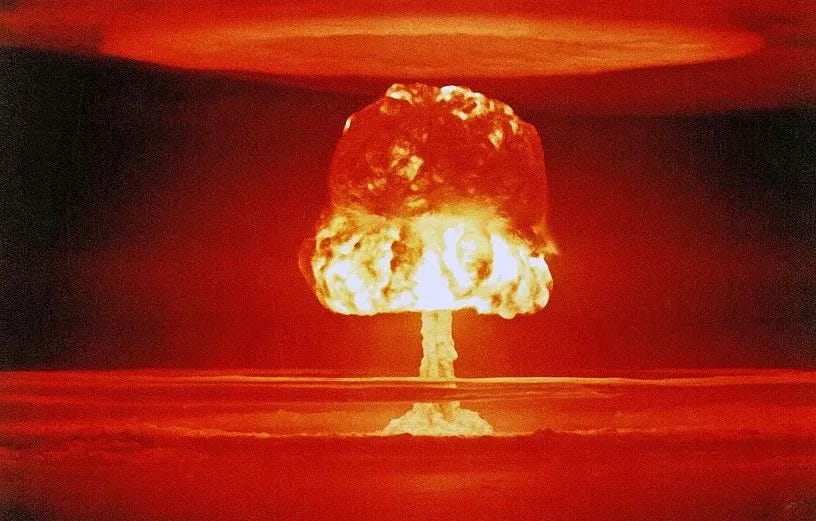
A thermonuclear explosion happens in milliseconds. The establishment of a new culture cannot be that fast, but the sudden widespread adoption of the smartphone is not something to be underestimated either. In less than a decade, the whole world—and this is not a figure of speech, I am literally talking about the entire world, across every continent and spanning age groups (over 65% of the global population now owns a smartphone)—has become equipped. Every institution and every corporation has been affected as well, from the American Civil War Association to the military, by way of your local library. The Internet has penetrated every facet of society. You are nobody anymore if you don’t have an email address, social media accounts, and several other official applications. Most bureaucratic activities have now been digitized.
The economic landscape has been leveled by information technologies just like Kansas City is by the nuclear detonation in the movie. Kodak and some entire industrial parts have completely vanished while others, like the legacy media have been turned upside-down and would be unrecognizable to an 1983 person. No one has been spared. There are even dozens of “prayer applications” whatever that means.
Fall-outs
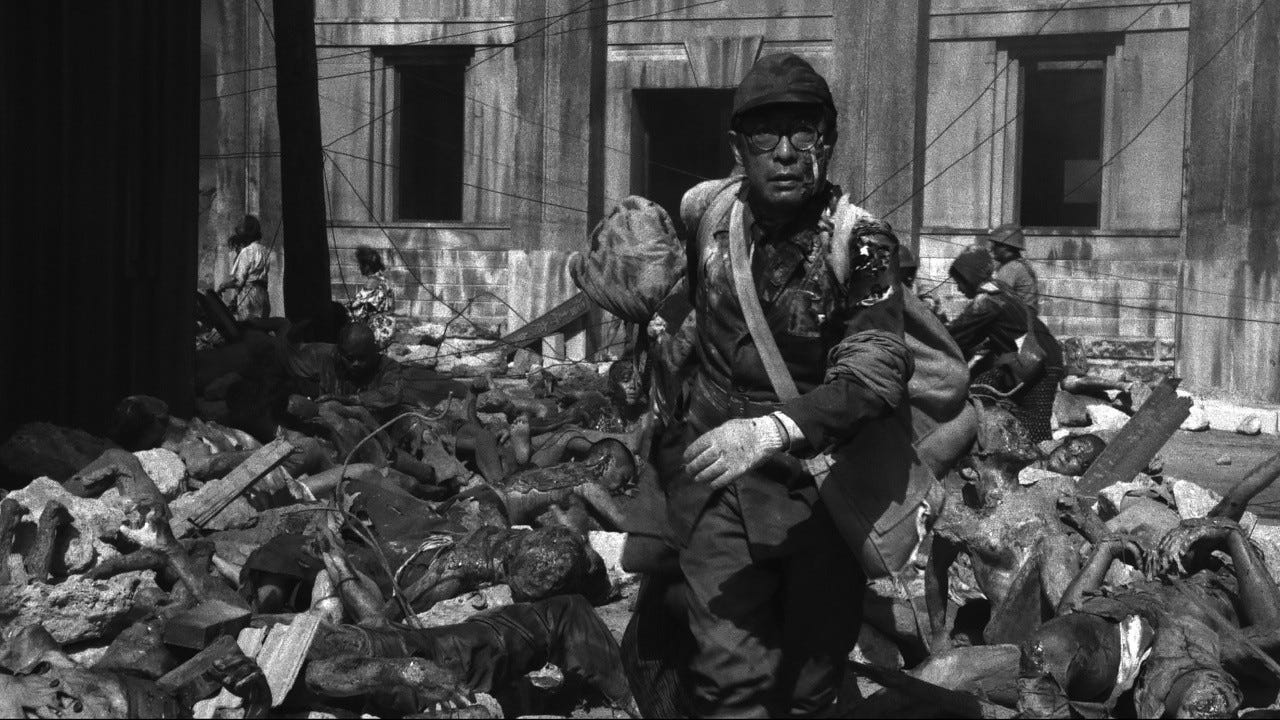
The point of the movie is to show what happens after the catastrophe: chaos, despair, and survivors struggling to organize and figure out what life will be like. There are attempts by the authorities to regain control—a speech by the president, a lesson on how to grow corn on contaminated soil—but these feeble attempts are shown to be completely out of touch with the new reality. There is a veneer of order (people wait in line), but a farmer is killed by squatters without a word being exchanged, and food riots show how fragile this “new normal” really is. The final scene of the movie is a radio call to which no one answers.
Life goes on, but how? In real life, the loss of faith in institutions is perhaps even worse than what is depicted in the movie. People today seldom believe in authorities anymore. A decade of Trumpian politics has perfectly illustrated this trend. Now the entire political class has adapted to the news cycle mechanism, abandoning any sense of accountability along the way.
While the EMP destroyed electronic equipment and made communications almost impossible in the movie, today it is rather a series of individual choices that has made a global consensus impossible. At least in 1983, people had a shared vision of what life in common should be and collectively grieved its loss. Today, that shared vision is gone, and the most consequential policies that have been implemented were never voted on nor presented during election campaigns. Take immigration policies, for example: no party ever ran on increasing immigration, yet that is precisely what occurred. From the institution’s perspective, even discussing these policies has become taboo.
Radiation poisoning is not immediate. This is portrayed remarkably well through the slow decay of the victims in the movie. People lose hair, teeth, and ultimately their grasp on what is happening to them. I couldn’t think of a better allegory for our times. There is no longer a clear North Star, and people raised in a written culture are having a hard time orienting themselves in a digital culture. Those who are digital natives are too young and have never been guided by their elders through it. Maybe it’s like Odysseus’s Odyssey that took years—even though the Mediterranean Sea isn’t that big—or Abraham’s wanderings in the desert (which isn’t that big either). Odysseus wants to go back (to the written culture), while Abraham wants to venture forth. The circle vs the line, the Knight vs the Bishop. We are at this crossroads once again.
> The circle vs the line, the Knight vs the Bishop. We are at this crossroads once again.
huh?