
Only Fans

France is undergoing the most severe heatwave in its recorded history. It is so intense that less than 1% of the Earth is hotter than the French countryside at the time of writing. This shocking statistic is also a perfect allegory of how the phenomenon is experienced on social media. Clearly, there is a heat bubble over France due to peculiar circumstances. Of course, systemic explanations are the only ones discussed. No one has any model to give an explanation that is not just hand-waving, but it is just like any other conspiracy: its defining feature is that you outsource the search for evidence to the opposite side and conclude that the conspiracy is true, or established, if they can't provide a smoking gun that you are wrong. Claiming a proof of absence from an absence of proof. Because what can be witnessed here is that the climate is changing, why and how is less clear (why in France particularly given that the phenomenon used to explain it is worldwide). This event is particularly illuminating of the general cultural climate in the virtual world.

The real and the virtual
The stark difference between the virtual and the real could not be more clearly delineated than in the social media cycle linked to this meteorological event. On French Twitter, the conversation revolves around AC (is it moral, useful, imaginable, etc.) and grand, sweeping considerations, resulting in statements like: ‘It is because of capitalism; vote for me in the coming elections.’ In the meantime, the irrelevance of institutions is highlighted by ministers intervening to give advice on how to dress, drink, or when to shut or open windows—every foolish thing you can think of and more. The total lack of influence over events is only matched by the multiplication of statements that are completely out of touch. It is the micro-management (or ‘nano-management,’ which would make more sense at this level) of a macro-event. And, for once, this is a true outlier: many absolute records, such as peak temperatures or nighttime lows, have already been broken.
There is a palpable sense of disconnection between the commentary and the lived experience. ‘Omniconvergence’ can be witnessed in this episode because most of the commentary attempts to force pre-existing narratives onto the unfolding event. This ranges from the ‘europoor’ discourse —europeans are too poor to afford AC—to climate activists—who suddenly forget that ‘weather is not climate,’ despite arguing the opposite three weeks ago when the beginning of June was cold—to politicians trying to link the temperature to their pet causes, from anti-capitalism to raising salaries for this or that sector. The hyperpresent theory can be witnessed in all its scope: whatever your personal preoccupations, a link will inevitably be drawn to the temperature. It shows how the digital revolution shapes the global discussion: if you want to be heard you have no choice but to talk about what is at the root of the social media cycle du moment.
This peculiar moment is illuminating not just in the how of the digital culture, but it is also very good to expose the underlying moral infrastructure of the times. This aspect is rather felt than explicit. It expresses itself in the tonality of the commentaries and is not without reminding an ancient theological school of thinking.
Digital Performative Jansenism
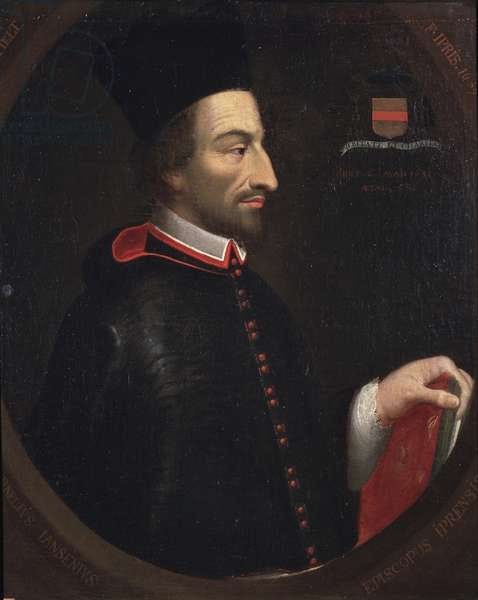
Jansenism was a rigorous theological movement within 17th-century Catholicism. Rooted in an austere interpretation of Saint Augustine’s writings, it emphasized the profound corruption of human nature by original sin and the absolute necessity of divine grace for salvation. Jansenists argued that because human free will is severely limited by sin, only the unmerited and ‘efficacious’ grace of God allows an individual to perform good works or attain righteousness. This doctrine fostered an intense, moralistic lifestyle characterized by humility, rigorous penance, and deep skepticism toward the frequent communion practices promoted by their rivals, the Jesuits, whom the Jansenists accused of moral laxity.
If you read the previous paragraph through the following lens—where the grace of God is replaced by climate stability and sins are defined as CO² emissions—the parallel with the tone on social media becomes immediately visible. Since humans cannot live, or at least breathe, without emitting CO², which is now viewed as the root of evil, they are in a constant state of sin. The implications are very concrete and invasive. This climate eschatology serves as the moral justification for the war against air conditioning and almost every aspect of daily life: from how you flush the toilet, to the necessity of daily showers, to what you eat—since the latest heatwave is, of course, blamed on the burger you just consumed.
A major difference between original Jansenism and 'Digital Performative Jansenism' (DPJ) is that the former was deliberate and explicit, whereas the latter is implicit and largely unconscious. The performative aspect lies in the constant moralizing tone adopted in social media discussions: moral judgment serves as the starting point rather than the conclusion. One must publicly demonstrate their penitence—such as by 'surviving' without air conditioning—as proof of being among the elect. Ultimately, this reflects yet another unexpected example of convergence.

Journalism Ethics (and the absence thereof)
Observing how major news outlets report on this event illustrates a larger point: the unexpected confluence of journalistic ethics and the lack thereof among content creators. The pitch is as follows: there is a hook designed to farm clicks. For OnlyFans creators, the hook is based on physiological cravings—essentially naked or exposed bodies, the not-so-secret ingredient of advertising since the advent of mass media. For journalists, the hooks are based on moral berating: ‘You must suffer because you have been very bad and released too much CO²
Not only have journalists shifted from information to opinion, but they are also using every world event to rehash their own worldview, turning confirmation bias into a lifestyle. Furthermore, they clutter their headlines with terms that function like polarizing images—words like ‘tipping point,’ ‘heatwave and anger,’ ‘preoccupied,’ ‘people are dying at home,’ etc. These terms are not new, nor are they informative; they are used purely for clout. There is very little coverage on how society could adapt—I am thinking of things like adjusting school calendars or mandating AC for public buildings. Instead, they focus on shallow moralizing and ‘shock and awe’ press releases.
I am certain this subject will vanish from the global conversation within a week or two after the event, just as a sex bot gets buried in your social media feed by newer bots. We are left with this paradox: on one hand, it is the ‘end of the world,’ but on the other, next week will be dedicated to a different ‘end of the world.’ Social media already flattens the informational space because messages are hyper-formatted, but this behavior flattens it further; the atmosphere projected by mainstream media is always the same. News cycles have become equivalent to one another, ranging from an egregious Trump tweet to a historic heatwave with measurable societal implications. It is structurally equivalent to the increasing insignificance of traditional sex symbols and stars, now replaced by a deluge of AI-enhanced influencers.
Journalists and activists used to be the ones who brought important stories to light. From Watergate to Erin Brockovich or Glenn Greenwald’s NSA revelations, compare those stories to the media coverage of extreme events like the COVID-19 pandemic or the NordStream sabotage. It is not that these stories are hidden, but rather that no one really cares anymore.
Fatigue is the name of the game. And it is not by accident. The theological structure of DPJ makes it an inescapable consequence: there is no individual salvation possible. Perpetual penance without the possibility of grace is exhausting, just like the sun in this afternoon.