
IT Story

In my previous post, I was talking about the impact of information technologies on the cone of plausibility. It was mainly from the point of view of the cone of the future. It turns out that the cone of the past is also transformed. It appears paradoxical because we can’t change the past, but history is not like physics. There is no history outside of the understanding of humans talking about it. The photon moves at the speed of light in a vacuum and won’t be bothered by any discourse. The same is not true regarding so-called ‘historical events’. Hence, what would be surprising is if the switch to digital culture did not change our perceptions of the past. How would you like your history portion served?
Small
Access to culture was traditionally mediated through books or lectures. Today, we have short videos on TikTok and other reels. These are punchy clips of less than a minute, optimized for virality. Most kids learn history through that channel. It is just a bare observation. The structure of such bits of culture is very formatted. It is reminiscent of porn scenes that are scripted to optimize the audience. The comparison holds very well.
In the case of ‘history short videos’ it looks like this: they start with factoids and are interlaced with moral judgments that pre-existed the video. They are not learning material, nor are they trying to convey wisdom. In this, they differ from moral stories like those of Aesop. TikTok history is here to reinforce a narrative. Factoids are used as emotional proofs and signifiers of the importance of the subject. They also act as borders to avoid further discussion: “but they are facts.” The factoids are floating in the ether and are impossible to put into context. The role of the emotional layer is to provide immunity from deeper inspection.
In terms of cones, it means that the cone of the past has become thinner—the complete dual of the cone of the future. History is visited along very specific details that are highlighted and cut off from any explicit context. Actually, they are indeed embedded in a narrative that remains implicit, and their only purpose is to reinforce that narrative. Observe that they never raise genuine questions. They are rather like modern versions of a political advertising campaign: either a “gotcha” or the strengthening of the narrative (writer note: I wrote this sentence alone even if it sounds like AI generated maybe the technology is rewiring my brain in real time). They are not there to convert; they are there to maintain the integrity of the herd. Stability is the political gold of digital cultures.
If we take a step back to observe this phenomenon—the herd immunity towards concurrent narratives—we arrive at the medium-sized level of ITstory.
Medium
On my timeline, I have noticed the disappearance of left-leaning voices. The Algo knows best. It means that I am going to be structurally exposed only to narratives that are close to the ones I am developing. I am afraid that with LLMs, it is going to get worse. Before LLMs, information bubbles existed. They were drawn based on your reactions and other metadata: who you respond to, which accounts you like most, etc.
But LLMs introduce the possibility of semantic analysis. Grok can now, for all intents and purposes, read my posts and act accordingly. It is very costly, and I doubt that it is used today, but it will be. Sooner rather than later.
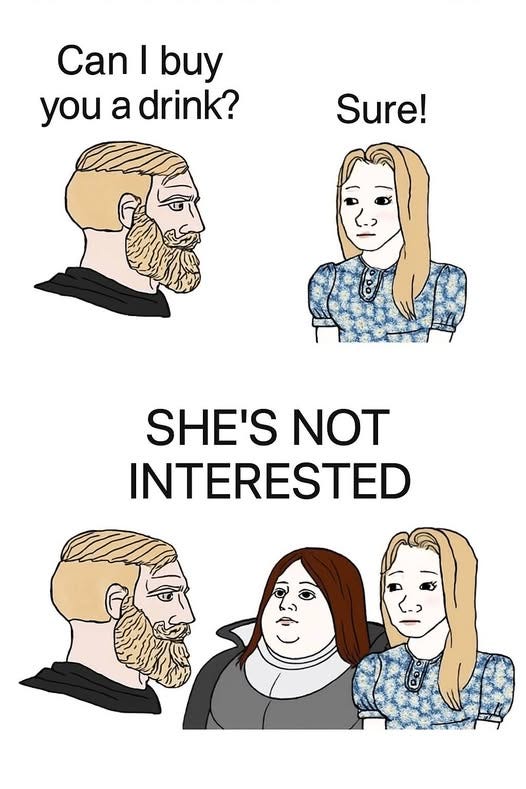
Therefore, the structural incentive from social platforms is to push content creators to publish soundbites, takes, and short videos as described previously. The only currency on social media is attention, and by construction, the platforms are going to spread your message to your think-group. If you have been identified as blue and publish a point that sounds red, what is going to happen? Nothing. But nothing for real; no one is going to see it because the Algo is going to assume, for your own good and safety, that your usual audience is not interested.
Large
If we take another step back, we have a gloomy picture of the public conversation. First, there is no longer a public conversation, but thin threads that don’t interact much. Massive improvements in communication technology have directly led to more isolation. It is a strange kind of isolation because you are in touch with individuals on the other side of the Earth.
But more than that, the lack of interaction is also a lack of feedback. One argument for free speech is that people who say disagreeable things can sometimes be right, and overall, it is bad to be cut off from their inputs. A system that only feeds on itself and doesn’t adapt its interpretative structures is doomed to diverge. How is this going to be translated into concrete terms?
Extra Large
This is hemiplegic metaphysics at best. As I have discussed here, you need both positive and negative feedback in order to extract wisdom from the universe. What has been observed here is that, structurally, social media platforms favor positive feedback loops. And this is a zero-sum game: if you spend your time reinforcing what you already know, you have less time for doubt and critical thinking.
If you want a picture of the future, imagine a boot stamping on the accelerator—forever.