
Flattening Cones

There is a famous scene in Monty Python and the Holy Grail where Lancelot rushes toward a castle. It’s a short clip, less than a minute, and since seeing it is better than any description I could give, I’ll let the scene speak for itself:
This scene is perhaps the best allegory for our social media environment. Our times are indeed best described by continual digital chitchat that seemingly leads nowhere, followed by real-life bursts. The period preceding the George Floyd riots is the first idea that comes to mind. One could retort that there were specific conditions linked to the COVID crisis… but precisely, since then, we are always more, rather than less, inside a crisis. The exceptional has become the ordinary.
The new anormal
Digital life is full and empty at the same time. Just like Lancelot, you are constantly doing something and nothing at the same time. Scrolling is simultaneously active and passive. This structure is not paradoxical in a digital culture; it is the default. The reason why can be traced back to computers, and more precisely to browsers, which are the infrastructure of our times. Today’s most important use of computers is no longer to actually compute something; it is to communicate across systems. And unlike computation, which has an end, there is no end to communication. You are always waiting for the next bits to arrive until you are disconnected from the network—or you die. The blossoming of red notification dots is a never-ending skin condition. Talk about endocrine disruptors.
Moreover, on machines, waiting is not an idle state: technically, it corresponds to an infinite loop of checking file descriptors to see whether or not a state has changed. This is exactly like doomscrolling. From this perspective, social media users are like computer daemons. In computer science, a daemon (pronounced 'demon') is a program that runs in the background rather than under the direct control of an interactive user. The social media user—the digital version of the citizen—is supposed to be the background process of democracy. Public debate is meant to inform representatives of what is happening and what the trends of society are. But is that actually the case?
The lack of persistence, compounded by the notification deluge, suggests that the answer is negative. It appears to me that the demon’s job is rather to prevent any potential synchronization between free citizens from emerging. Thus, the demon might be better viewed as a distributed malware, turning citizens from useful to useless background processes. This was achieved through the spread of social media over the span of a decade. The Algo seized power through its trends and suggestions. One user at a time. One online community at a time. One country at a time.
Just like Lancelot in the clip, before you know it, you find yourself deep in an Authorization Based Citizenship dystopia. Because institutions have felt power slipping from their hands, they have reacted by becoming increasingly authoritarian. Right now, it is all about age verification—’for your safety’—to be able to post on social media. By doing so, they have inverted the source of legitimacy: in a republic, legitimacy emanates from the citizen and is transmitted to institutions via the vote and a myriad of practices. In our new environment, you must first have the right authorization, delivered by the administration, before opening your mouth. For all intents and purposes, the flow of legitimacy has been inverted.
The Algo and the global conversation
The emerging landscape is hard to picture. It is in fact due to the interactions of new actors, the founders and CEOs of global corporations that have acquired powers rivaling to those of nation-states, and technical implications that are too complex to fully understand. Of course the engineers of a social media platform can tinker the algo, but don’t forget that a large part of it is also constituted by the collection of individuals reaction to it. There are feedback loops at work everywhere making it very difficult to understand how it works. Moreover, since a lot of it comes from individuals and their silly behaviors it is even harder to make a coherent model. Chances are that there is no such model in the first place. The AI won’t understand better either. Let me show you a stupid little experiment to illustrate this point. I am going to give few lines of a french rap song:
Non ! Pourquoi moi ? C’est une erreur
Garde-moi, je suis noble de cœur
Arrêtez la chaleur, j’crache sur Belzébuth
Je garderai la foi et puis j’ai l’uppercut
Pourquoi ce blâme ? Pourquoi ces flammes ?
Pourquoi ce torréfacteur qui nous crame ?
Cet âne de Sheitan plane sur nos âmes
Il vit par le feu, périra par le lance-flammes
Du Lac Lancelot, double A du Graal
Solaar pleure — MC Solaar
The literal translation makes little sense. It would be something like “No! Why me? It’s a mistake Spare me, I am noble of heart Stop the heat, I spit on Beelzebub I’ll keep the faith, plus I’ve got the uppercut Why this blame? Why these flames? Why this roaster scorching us alive? That jackass Shaitan looms over our souls He lives by fire, he’ll die by the flamethrower From Lancelot’s Lake, the Grail’s double-A”. There are puns that only work in French: ‘Lancelot’ can be heard as ‘Lance l’eau,’ which means ‘throw water’—a phrase that makes perfect sense in the context of hellfire. Likewise, the line ‘Je garderai la foi et puis j’ai l’uppercut’ plays on the fact that ‘foie’ (liver) sounds exactly like ‘foi’ (faith). Although it is written as ‘faith’ in this instance, the double meaning implies a physical alongside a spiritual understanding.
I tested this short text on Claude. Of course, it couldn’t see the connection to the current post, but you, the reader, can. I asked it to explain the puns and the different layers to me, and it failed miserably. I had to explain the not-so-hidden messages that I had just laid out.
Now, if ten lines of text can bamboozle a top-of-the-food-chain AI, do you think there is any chance such a technology could grasp anything of value regarding the interplay of biology, social dynamics, and technical layers?
The answer, of course, is that it doesn’t understand shit. It is even doubtful that humans thinking about it 24/7, like me, can. Still, the natural question remains: what can we actually say about it at this point? Can we still make sense out of life in this new era?

Silly cones
The cone of plausibility is an intellectual tool devised by C. Taylor in a military context during the 90s. The idea is:
The “Cone of Plausibility” is a name for a theoretical process that can be used by one or more persons to project trends and events and their consequences holistically into the future. Use of the “Cone of Plausibility” permits a logical progression into time and the creation of alternative scenarios at preselected points or intervals called forecast or planning focus planes.
And here again a picture is worth many words. Here is the graphical representation of this idea:
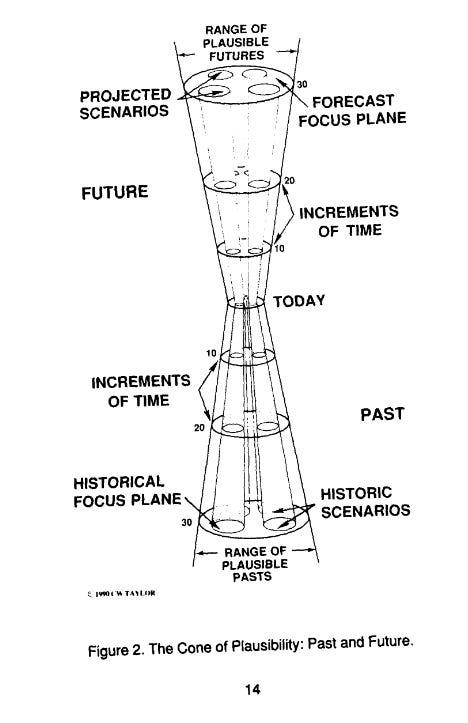
Digital technologies have flattened the cone. Imagine sledgehammering the diagram above. The time horizon has shortened in distance but widened in gap. This is another way to visualize the multiplier effects of these new technologies. Just like adding silicon to Kim Kardashian’s silhouette, adding computing power and CPUs—also built out of silicon, mind you—is changing the landscape. Kardashian almost single-handedly shifted beauty standards for a decade, a feat that would have been technically impossible without digital technologies. By the way is she getting older or is she just reconfigured, ready for a new round just like Lancelot in the scene? What does this tell us about society in general? It seems that a convergence toward uniformity is the overarching trend. Almost every country reacted like China during the COVID crisis; moreover, the ‘solution’ went against all previous research. Generalized lockdown was never considered a viable solution in the history of pandemics, yet this approach seemingly imposed itself across the globe in just a few news cycles. Thus, the cones of plausibility have morphed into something entirely new.
Markets are supposed to be the places where we discover the objective contingencies of the world. The price signal is used by actors to orient their efforts. In essence, the market is a technology designed to restore sanity and objectivity. Or at least, that is how it used to work. The conflict between the US/Israel and Iran tells a different story. The price of oil on global markets seems to be more impacted by social media noise than by concrete realities. It is another striking example of the profound impact of digital technologies on our world.
On a long enough timeline, you cannot ignore reality forever. The price of oil will reach its true value, Kim Kardashian will grow older, and Lancelot will eventually reach the castle and enter a killing frenzy.