
Doppelgänger

My grandfather travelled a lot. He was ahead of his time in that respect. He wanted to see the world with his own eyes, and he did so mostly before the ‘70s. At the time, just taking a plane was an adventure, at least to me. Half of the world was behind the Iron Curtain, yet he went to Moscow and to Soviet Czechoslovakia to hunt. He also went to India and South America, which was really impressive at the time for Europeans. He had a piece of furniture in which he kept objects that were tangible memories of his travels: a Gurkha knife, a small statute of an elephant carved in an elephant tusk among other mysterious objects. Each artifact came with a story attached to it.
Sixty years later, the average urbanized, upper-class Western adult has travelled more before their forties than my grandpa did in his whole life. Yet, the material aspects of the millenial journeys are vanishing. They don’t bring objects back but rather post Shorts on Instagram and tell stories—but just once, and for people they don’t actually see. Just before them came the Boomers with a completely different approach to travel. Houellebecq’s literature might be a good pointer for the description of this tidal wave of localized-in-time migrations. World travel became a mass sport before communication caught up with the Internet. In the meantime, people got stuck in an everlasting present. Time travel stopped or freezed rather. What happened?
Doppler and redshift
The Doppler effect is most easily explained by the changing sound of a police siren as it approaches you and then moves away. You can literally hear it. This is also the effect that police officers use to measure speed with radar (your moving vehicle changes the wavelength relative to the speed of the car).
At first glance, this calls to mind cosmological redshift. One could legitimately think that redshift comes from a Doppler effect of two galaxies moving away from one another. However, this is not the case; with cosmological redshift, the galaxies aren’t actually “traveling” away from us through space like rockets. Instead, the galaxies are relatively stationary, but the fabric of space between us and them is expanding.
These two effects find their doppelgängers in human experience through the way we grasp our memories. My grandfather experienced the standard Doppler effect, whereas we, due to the digital revolution, are experiencing a redshift-like phenomenon. Let’s unpack this.
With every story that my grandfather told, a new detail or a new turn of events was added—no doubt to make fresh what was otherwise a repetition of old memories. On the other hand, the memory of millennials on social media is perfect. The pictures and short videos don’t change. Yet, millennials are rarely connected to those perfect memories. The search for views pushes them to constantly produce new material. Like in cosmological redshift, they themselves don’t move, but the fabric of the virtual space expands, cutting them off from their perfect records. Both are twisted ways of accessing recorded memories. One is human; the other is algorithmic.
An emergent property of the cosmological redshift is found in the blackness of the night. As the universe expands, light has more and more distance to cover, and parts of our universe will remain hidden from our view forever. It is a very fitting allegory for social media messages that exist but are buried under a deluge of new messages. No one will ever read them again except for the machines building your timeline and answering your prompts. As such, they form the invisible fabric of the virtual space.
If we shift our viewpoint, there is that of the objects that have crossed through time. Those objects don't make you travel in time personally. It is not about your memory, but about culture. Curiously, they happen to be the destination of many journeys that will build your own memory. From this viewpoint as well, digital technologies have an impact.
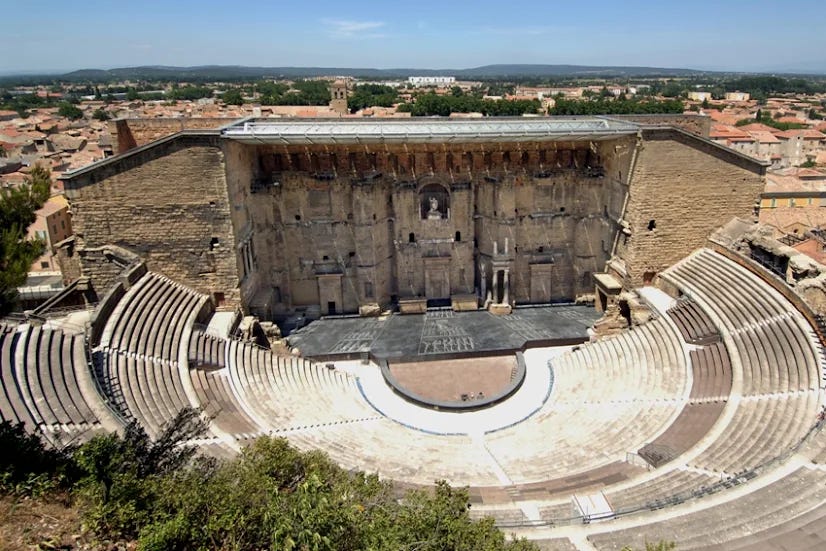
Architectural archives
We are in the midst of the month of May. In France, this means that there are a lot of public holidays, a blend of the remnants of war and the Catholic culture of the country. I live in the southeastern part of France, along the “Rhône Valley”. The Romans used to expand into this region and left traces everywhere. My grandfather was the CEO of a social housing company; for him, finding archaeological remains was a curse. It meant a project would be blocked for years.
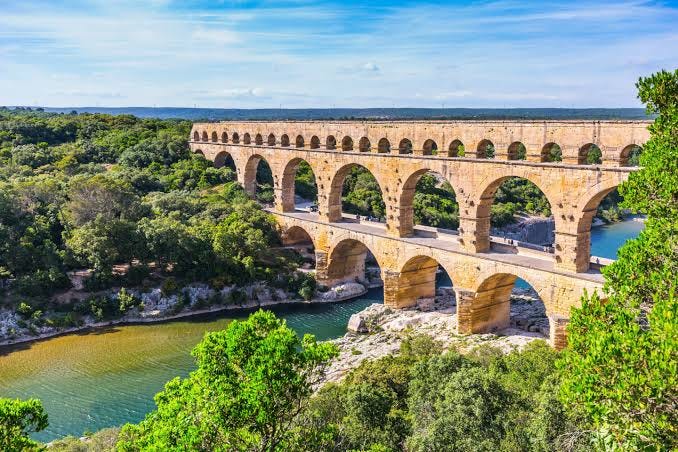
I used those few days to visit classical monuments with my wife and daughter: the Orange Theater, the Nîmes Arena (“arena” is a trendy name for modern stadiums, but this one has been continuously used for various purposes for 2,000 years, for real), the Pont du Gard… These are huge artifacts coming from the past—a long past stretching over millennia. It is another way to work on memory and legacy, rather than just personal memory. These architectural objects are telling another kind of story.
What will be the remnants and stories bequeathed by our digital culture? For instance, is it possible to make something out of the mass of social media exchanges? Maybe, but at best, those stories will be built and told by machines because of the deluge of information to handle. It looks like here too, on a cultural memory level, machines will be our historians. Those things can’t be touched or seen within their natural framework. They won’t be located in meat space either; any server could do the trick.
Another idea that struck me was the following: how will memories scale across time in a digital culture? What struck me in particular was the structure of the Pont du Gard. It is a famous aqueduct, and it consists of a small bridge built over a medium-sized bridge, itself built on a larger bridge. How do memories compound over time? Can we engineer something like that?
Even the mere technical issue of transferring digital assets to the next generation hasn’t been solved. Let alone a more complex construct like culture. There is no death in the virtual space. This is true for video games, which can be restarted as many times as wanted, and also for social media accounts that stay there after the death of the user. On the one hand, you can be banned and disappear in the blink of an eye; on the other hand, your profile might stay open and become a small point in the network. Like a distant star fading away.