
A Maze Inc.

Palantir has been making the rounds on social media following the publication of its manifesto. This move by a major player has paved the way for other corporations to publish their own versions. For instance, take Nym, a startup that positions itself in polar opposition to Palantir despite acting the same:

Since Palantir focuses on AI and database integration while Nym operates in the internet privacy sector, their opposition will come as no surprise. Similar examples abound, and many more manifestos of this kind will likely emerge following this publication. The natural question is: what exactly is this? Whether it is merely a fad or a sign of deeper structural shifts—and how it will unfold from here—is what we will explore below.
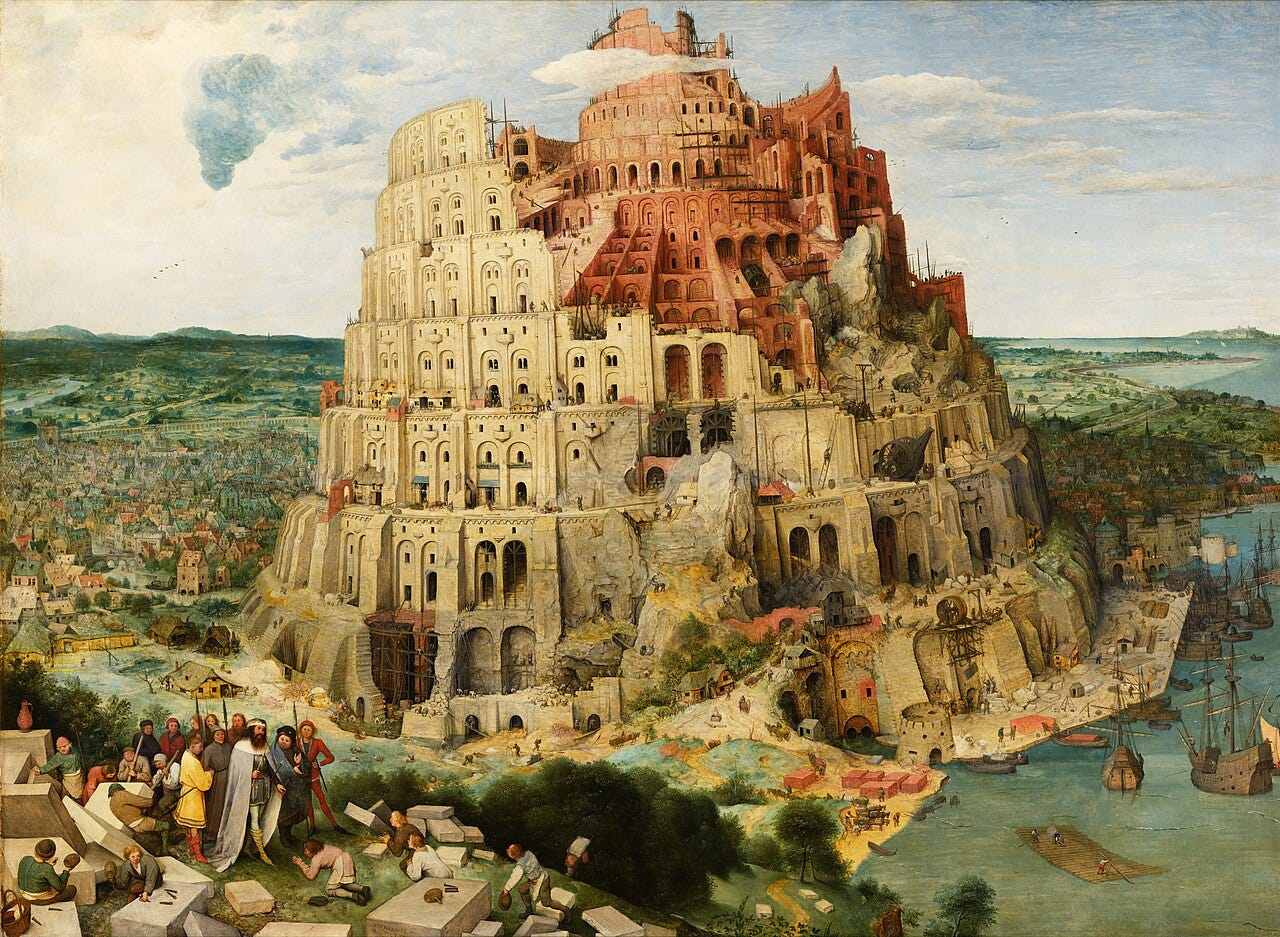
What is going on ?
Since the start of the second Trump administration, I have maintained that the most significant political opposition will be between the Deep State and Deep Tech. Palantir and Nym, while opposites, both belong to the Deep Tech camp. As I have previously analyzed in these columns, the powers that be are increasingly resembling distributed systems rather than vertical administrations.
The move by both companies is telling: even if they disagree on almost everything, they agree on the most important point—as Bob Dylan would say, “the times they are a-changin’.” They have both diagnosed that old forms of power are reaching a point of obsolescence. That they share this view is not surprising; what is more interesting is that they now feel the time is ripe to go public with it.
This shift marks a new phase: Deep Tech is openly challenging the Deep State’s legitimacy. This is a profound move because, according to Max Weber, the modern state is defined by its monopoly on the legitimate use of physical force. If you read both manifestos, they touch on areas—weaponry, cryptographic tools, the organization of power—that sit at the very heart of the nation-state.
The fact that these manifestos are surfacing during the war in Iran and following the US intervention in Venezuela is no coincidence. One could also point to the threats against NATO members, the US withdrawal from the WHO, or the renewed agressive claims on Greenland. The hegemon is no longer playing by the international rules it established post-WWII. The entire political organization of the world is being renegotiated before our eyes.
My analysis is that such a reorganization is not optional. As we transition from a print-based culture to a digital one, many institutions tailored for the former are becoming obsolete. Today’s world order emerged from the Thirty Years’ War, which was itself a consequence of a revolution in communication: the printing press led to Protestantism, which in turn sparked the European wars of religion.
This shift is also evident in how these powerful corporations communicate. For instance, Palantir recently posted on X: “Palantir is proud to partner with the US Department of Agriculture to modernize services for American farmers, giving them the time and resources they need to secure our nation’s breadbasket.”
I’ve highlighted Palantir due to recent events, but other major players like Amazon follow the same pattern. Their wording is telling: “Amazon Web Services has agreed to provide U.S. government agencies...”
You read that correctly: it is Amazon that has “agreed” to help the U.S. government, not the other way around. Contrast this with the wording used less than a decade ago. Take, for example, this headline: “Amazon’s Bid on a $10 Billion Pentagon Contract Is Riddled With Conflicts of Interest.”
At the time, Amazon was bidding on major contracts (triggering extensive legal warfare). The company wasn’t “agreeing” to assist government agencies; rather, it was—at least publicly—vying for a seat at the table.
And this is without even mentioning Starlink and its direct implications in the war in Ukraine—where it effectively decides whether or not the internet remains functional for either side. SpaceX is, of course, far more powerful than its governmental counterpart, NASA, and space is, after all, the next frontier.
These manifestos are concrete manifestations of the crumbling old order. These shifts do not happen overnight, like in a Hollywood movie. In real life, the fall of the Roman Empire was more like the collapse of a bridge that had long suffered from a lack of maintenance. No one was awakened in the middle of the night by a “Breaking News: Roman Empire Has Fallen” tweet. However, the situation today is not quite so simple: digital technologies act as multipliers and accelerators. This time, it may be different.
If the ground under our political institutions is shifting, then the individual experience of our shared world must shift too. The crumbling is not just institutional — it is also going to be phenomenological.

Lost
The natural follow-up to these remarks is to try to imagine what is going to happen. Predictions are hard, especially about the future, but let’s try to discern probable patterns.
I have been actively thinking about this revolution on a daily basis for years, and this Substack serves as a track record of that analysis. To be honest, I am more surprised than I can say. I can only imagine how unsettling this must be for the average person—someone who only thinks about institutions when tax day arrives, before returning to the more pressing matter of putting food on the table.
Even the political and elite classes are not fully prepared for such a paradigmatic shift. I expect “weird times” ahead, where one part of the population clings to the ancient model while another has already migrated to a digital culture. This switch is occurring across multiple scales and domains simultaneously.
Take AI, for instance. Some are vehemently opposed to it (just look at BlueSky if you want to see what I mean). While there are plenty of bad reasons to reject technological progress, what is striking is how this fracture even affects children: some use AI daily, while others are barred from it by their parents.
What we observe at the individual level is also happening to institutions. In the military, for example, the debate over whether to continue building aircraft carriers is becoming a major fault line and is linked to new technologies (drones etc.). But perhaps the most telling example is the COVID crisis—specifically the continued use of masks long after their absence of effectiveness against that specific virus became known and proved. I still see people wearing masks today (I was never seing anyone with a mask outside a hospital before); to me, they are living in a completely separate reality. They simply don’t see what I see. This kind of perceptual gap is about to manifest across the entire world, on countless subjects, all at once.
This is why I believe the current zeitgeist will be defined by a profound sense of being lost. The sheer multiplicity of visions emanating from these major players will not help. As I have noted, expect hundreds of similar statements to emerge in short order. These manifestos will convince some while alienating others, creating yet another chasm in the public sphere—much like how your social media feed is no longer the same as mine.
If this leads merely to misunderstanding—and frankly, misunderstanding might be the best-case scenario—for many others, it will lead to the feeling of being trapped in a maze of powerful actors who clearly do not share the same worldview. It will be like a conversation between a Taliban fighter and an LGBTQ+ activist. Everywhere. All the time.
Serious thinkers will find themselves lost in a labyrinth of competing propositions. Which ones make sense? Which will survive the next news cycle? What are the core beliefs of my interlocutor? What is this world we are building for ourselves? And what kind of world are our descendants going to inherit?
A maze Inc. isn’t it ?
A particularly interesting phenomenon I hypothesize will become more common as intellectuals are faced with numerous appealing propositions, is a reintroduction of both introspection (in the sense of analysing oneself honestly) and rethoric (as the paradigm shifts from truth-seeking to convincing).
That is, at least temporarily.
Put a pin in this: https://technocracyatlas.com/